


What does the plan-do-check-act cycle entail?
The plan do check act cycle consists of four successive steps through which processes are continuously evaluated and improved. The method is based on the work of W. Edwards Deming and is recognised worldwide within quality management and lean manufacturing. In practice, it is mainly manufacturing companies and logistics organisations that exploit the potential of this systematic approach.
-
Plan - prepare and analyse
In this phase, bottlenecks or improvement opportunities are analysed. These may relate to an inefficient material flow, excessively long lead times, high stock levels or ergonomic risks on the shop floor. Strategic goals such as increasing delivery reliability or reducing failure costs can also be triggered.
Example: a company notices that order pickers walk 6 kilometres every day. Data analysis shows that this could be done more efficiently. The objective is formulated: a 40% reduction in walking distance.
-
Do - implement and test
The planned improvement measures are implemented in this phase. This is often done on a small scale to reduce risks. Think of testing a new routing, adjusting a workstation or introducing a new storage concept.
Tip: Make sure operators and logistics staff are involved. They can provide valuable input and minimise resistance to change.
-
Check - Evaluate and measure
After implementation, performance is measured against predefined KPIs. Think throughput times, error rates, order picking time, or ergonomic load. The measurement results are objectively compared with the initial situation.
Example: After redesigning the workplace, assembly time per product fell from 4 to 2.8 minutes, and physical complaints among employees decreased.
-
Act - Standardise and adjust
When the measure proves successful, it is secured in the standard processes. This means adjusting work instructions, staff training, and possibly also adjustments in systems (such as ERP or WMS). If necessary, the improvements are further refined.
After completion of this step, the next bottleneck is looked at again, thus repeating the cycle.
Why is the PCDA method essential for manufacturing and logistics?
Companies in the manufacturing and logistics sector face changing customer demands, cost pressure and high quality standards on a daily basis. The PCDA method helps create structured improvement processes that lead to sustainable results. Especially in environments where speed, precision and safety are crucial, the plan do check act cycle delivers demonstrable benefits.
Advantages of the Plan-Do-Check-Act cycle:
- Substantiated improvement actions instead of ad hoc decisions
- Fewer errors and downtime in production and logistics processes
- Greater involvement of employees on the shop floor
- Securing improvements in procedures and standards
- Flexibility to respond quickly to changes in the market
- Lower operational costs through more efficient use of resources

Plan Do Act Check example: Improved workplace configuration
In a logistics centre, the picking process is found to be slow and leads to physical overload for employees.
- Plan: Analysis of warehouse layout, walking distances and order picking sequence. Goal: 30% faster order picking with less physical strain.
- Do: Design and implement an ergonomic picking location with modular flow racks. Test this on one zone.
- Check: Compare picking times and collect feedback from employees. Result: 28% time savings and fewer complaints about physical fatigue.
- Act: Apply improvements, roll out the solution to all zones and train employees in the new way of working.
A clear example of a pcda cycle with direct impact on productivity and well-being.
Application of the plan do check act cycle in workplace design and logistics
The plan do check act cycle is particularly valuable when designing or redesigning workplaces, assembly lines and logistics processes. Think of:
- Furnishing a new warehouse with efficient walking routes;
- Improving ergonomics in assembly workplaces;
- Optimisation of material flows between production and logistics;
- Application of lean principles such as FIFO systems or kanban in warehousing.
Multitube supports industrial companies in designing, testing and realising efficient and ergonomic facilities. Thanks to our modular systems, improvements can be quickly adapted and scaled up.
Common mistakes when applying the plan do check act cycle
Although the plan do check act cycle seems simple, there are pitfalls that can undermine its effectiveness:
- Insufficient analysis in the plan phase: Without thorough data analysis, wrong causes are addressed.
- Too big steps in the do phase: Overly ambitious implementations increase the risk of disruption.
- No or poor measurement in check phase: Without objective data, adjustment is impossible.
- Act phase is skipped: Successful improvements are not secured and disappear over time.
- Lack of support on the shop floor: Employees are insufficiently involved.
It is crucial to embed the PDCA cycle in the culture of continuous improvement. Training, communication and leadership play a key role in this.
The role of PDCA within Lean Manufacturing
The plan do check act cycle forms the backbone of many lean manufacturing initiatives. Whether it is 5S, SMED or Kaizen: they are all based on iterative improvement.
- 5S: With PDCA, workplaces are structured, standardised and improved step by step.
- Kaizen: Continuous improvement on the shop floor is only effective with cyclical evaluation.
- SMED: Reducing turnaround times requires analysis, test phases and assurance, the core of the PCDA method.
So the PDCA cycle is not an isolated technique, but a foundation for sustainable process improvement.
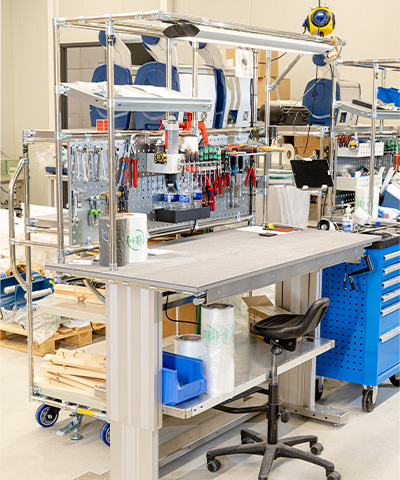
Starting successfully with the plan-do-check-act cycle
To make optimal use of the plan do check act cycle, you can follow the following steps:
- Choose a concrete problem: for example, a bottleneck in the warehouse or long changeover times in production;
- Use measurable data: objective data give direction to your analysis;
- Start on a small scale: test new ways of working in one department or production line;
- Evaluate and document: learn from the results and secure successful adjustments;
- Engage experts: external parties such as Multitube speed up the improvement process.
Conclusion
The plan do check act cycle is a proven method to structurally address process optimisation in production and logistics. Thanks to the cyclical approach, improvements are not only introduced, but also validated and secured. Whether in workplace design, warehouse logistics or process improvement: the PCDA method enables companies to improve continuously.
Organisations like Multitube help design, implement and optimise improvement projects. Through their experience in custom workstations and warehouse design, they offer practical solutions that fit within a PDCA approach.
Contact us for a no-obligation consultation or view Multitube's reference projects.