


What is Operational Excellence?
Operational Excellence goes beyond efficiency. It is a philosophy in which organisations strive for error-free processes, short lead times and maximum customer satisfaction. Central to this is the elimination of waste (muda), variation (mura) and overload (muri), concepts derived from Lean thinking.
Companies pursuing Operational Excellence build a culture in which every employee is involved in process improvement. Methods such as Kaizen (continuous improvement) and the 5S method (Structure and Standardisation) are important tools in this respect. This requires a working environment that facilitates flexibility, ergonomics and a smooth flow of materials.
Operational excellence and customer value: more than efficiency
Operational Excellence is not exclusively about cost reduction or process acceleration. The ultimate focus is on increasing customer value. Optimising processes so that products or services are delivered faster, more reliably and more consistently increases customer satisfaction.
In production and logistics environments, this means error-free deliveries, minimal waiting times and predictable quality. Every process step that does not add direct value for the customer is critically evaluated and eliminated wherever possible.
By putting customer orientation at the centre of process design and workplace design, Operational Excellence becomes a strategic driver for sustainable growth.
The role of workplace design in Operational Excellence
An efficient workplace is a direct translation of the principles of Operational Excellence. Supporting the work process with thoughtful design not only increases productivity but also reduces the risk of errors.
5S and workbenches
The 5S method forms a foundation for many companies striving for Operational Excellence. Workstations are set up and maintained according to five steps (Sort, Arrange, Clean, Standardise and Systematically Improve). Here, workbenches and height adjustable workbenches play a key role. By organising work materials logically and adjusting working heights ergonomically, employees can work more efficiently and healthily. Standardisation of workstations also ensures consistent quality and facilitates the induction of new employees.
.jpg)
Ergonomics as a productivity tool
Ergonomics in production is seen within Operational Excellence not only as concern for employees, but as a strategic factor for process improvement. Reducing physical strain leads to less downtime, higher job satisfaction and more consistent performance. Adjustable work benches, ergonomic tools and smart order picking carts contribute to this.

Warehouse layout and process optimisation
Also within warehouse design, Operational Excellence provides a framework to optimise workflows. By designing processes so that goods are moved and stored with minimal handling, both efficiency and error-freeness are increased.
Fifo and flow racks
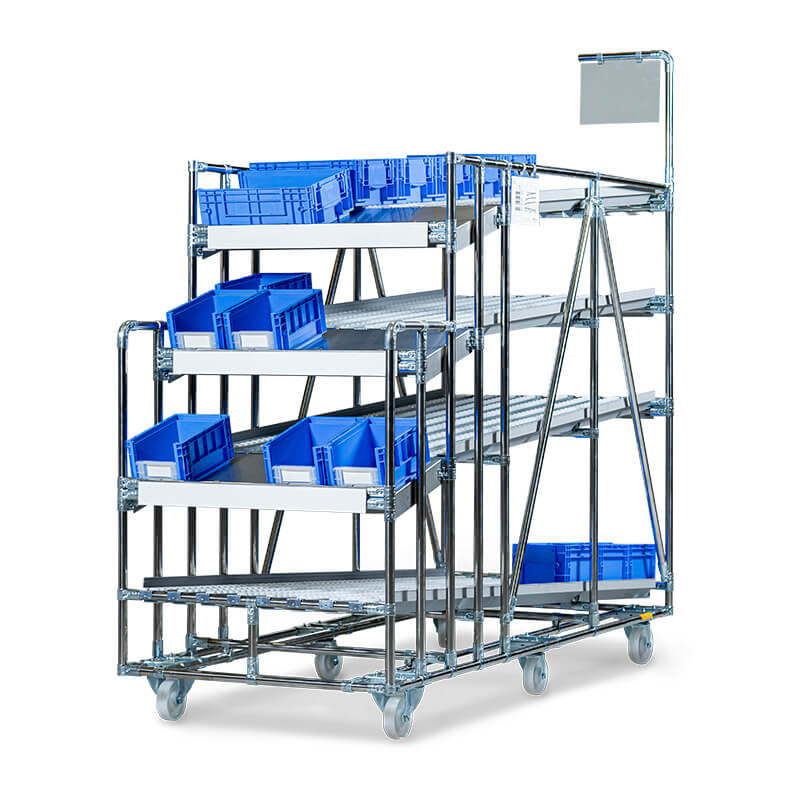
One example is the use of the FIFO principle (First In, First Out). By always putting older products out first, stock rotation is improved and waste due to obsolescence is avoided. Flow racks are physical tools that support this strategy by automatically bringing the oldest product forward.
Kanban and visual inventory management
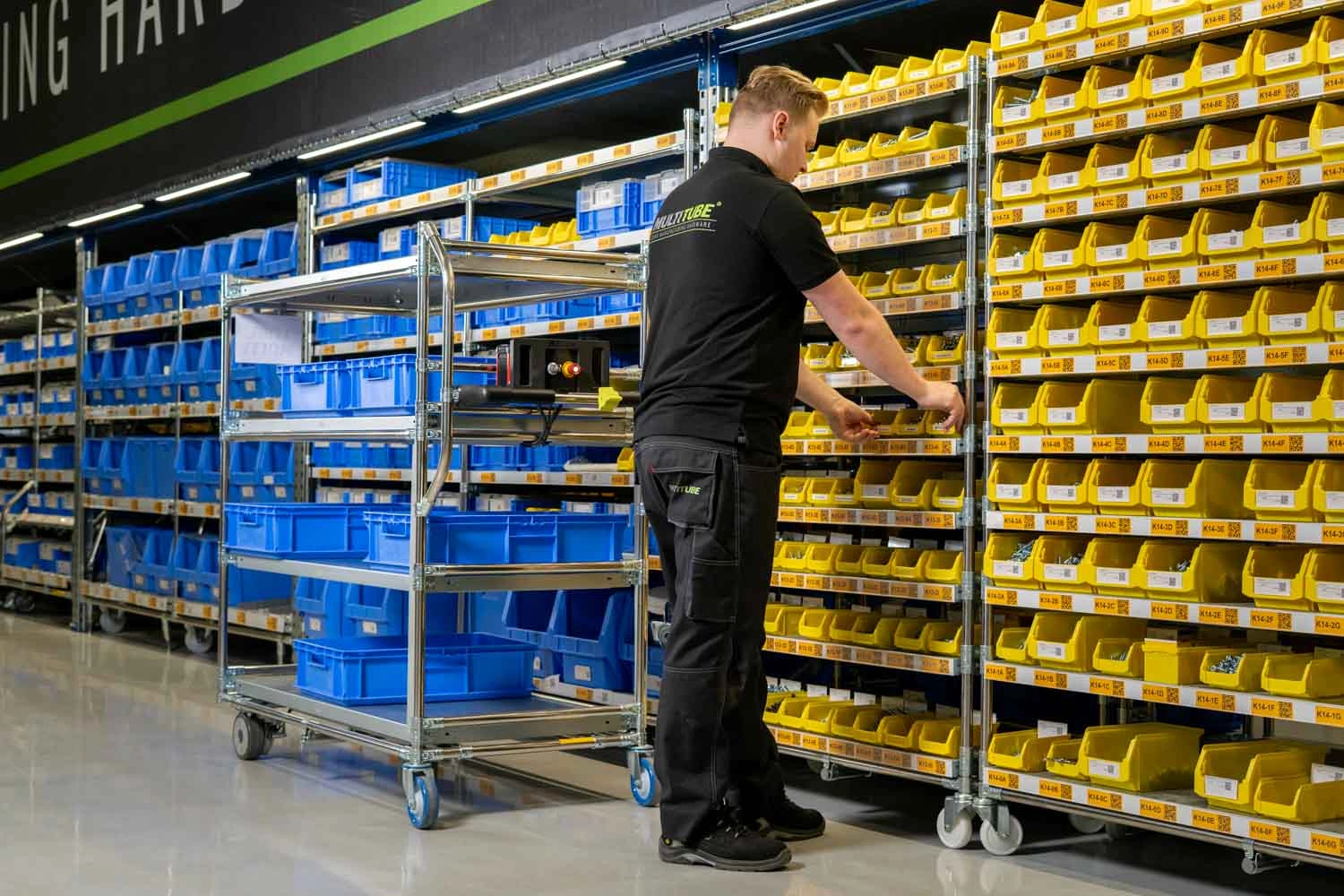
Another important application is Kanban, a visually-driven inventory management system in line with Just in Time principles. Kanban racks provide physical support for a kanban inventory, in which materials are replenished only when needed. This reduces inventory costs, makes processes more transparent and increases response time to changing customer demand.

Lean production and flexibility
Within Lean production, the focus is on value creation with as little waste as possible. This requires a layout that is easily adaptable to changing production needs. Modular systems for workstations, storage and internal transport support this flexibility.
The ability to quickly rearrange workstations or adjust warehouse trolleys makes organisations more agile and resilient to fluctuations in demand. Flexibility is thus an essential aspect of Operational Excellence.
Continuous improvement: kaizen as an engine for progress
A core principle within Operational Excellence is Kaizen, the pursuit of small, daily improvements. This means that it is not only major restructuring that counts, but rather the constant optimisation of existing working methods.
A flexible, standardised workplace set-up makes it possible to implement improvements quickly. By making physical processes visual and standardising actions, it becomes easier to spot waste and exploit improvement opportunities.
Performance measurement and operational excellence
Operational excellence requires continuous monitoring and improvement based on objective data. KPIs play a central role in this. Typical KPIs within manufacturing and logistics include:
- Lead time,
- First-Time-Right percentage,
- Number of movements per order,
- Number of deviations/errors.
Linking these performances to workstation design and warehouse design reveals which physical adjustments lead to process improvements. Well-equipped work tables, smart order picking carts and standardised kanban arrangements thus demonstrably contribute to the realisation of strategic goals.
Conclusion: the physical environment as a foundation for operational excellence
Operational Excellence requires more than just process thinking; it requires a physical working environment that facilitates continuous improvement. An optimal workplace and warehouse design based on principles such as 5S, Lean, Kanban, FIFO and ergonomics is an indispensable link in this.
Companies that invest in thoughtful workplace and warehouse design lay the foundation for higher productivity, lower costs and greater agility. With modular workstation equipment and smart warehouse solutions, Multitube offers the means to realise these strategic goals.